According to rule 1.3 there is a 30 seconds period after the last jam of a period during which an official review regarding the last jam could be demanded. In the officiating procedures this period is only taken into account at the end of the game, but not after the first period (see paragraph 2.6 of the WFTDA Officiating Procedures).
I would thus propose that the officiating procedures are modified as follows:
Once either the period clock reaches 0 during lineup or if the last jam ends after the period clock has reached 0, the JT blows a rolling whistle to indicate that gameplay has ended.
When the 30 seconds for demanding an official review are over the JT signals this with a new signal to indicate, that the period / game is officially over.
I would propose the following new signals:
End of first period: a short whistle blast followed by a long whistle blast
End of game: two short whistle blasts followed by a long whistle blast
EDIT: It seems relevant for this discussion that the 30 second time limit for calling an official review was only introduced with the 2025-rule-change.
I dont dislike the suggestion of making those 30 seconds more clear through some sort of visual signal. I would, however, be very unimpressed to see the final conclusion of the game changed to anything other than the rolling whistle, if for no other reason than the associated precipitous drop in style points such a change would bring.
I think the signal should be audible, not just visible. If people prefer it that way, we can of course also keep the rolling whistle at the end and introduce a new signal to signify that there is not going to be another jam (except for overtime jams or if refs decide that there is an additional jam).
However, isn’t the rolling whistle at the end of a period not ambiguous anyway? I mean if there were to be an overtime jam (or the refs decide that there is another jam to be played for other reasons) the lineup for this jam would be started with a rolling whistle as well. Thus we maybe should not use rolling whistle as a signal for the end of the periods/games at all?
The rolling whistle shouldn’t be blown at the end of the period until those 30 seconds have already expired (or teams confirmed they won’t be using their ORs), and it shouldnt take more than 30 seconds to determine if an overtime jam/additional jam were warranted. The rolling whistle, used correctly, is not ambigious. It ends either a timeout, or the period, participants can see which from the scoreboard.
I can see an argument for displaying that 30-second interval of opportunity on the scoreboard for the sake of clarity, but I’m unclear as to the real benefit of further modifications.
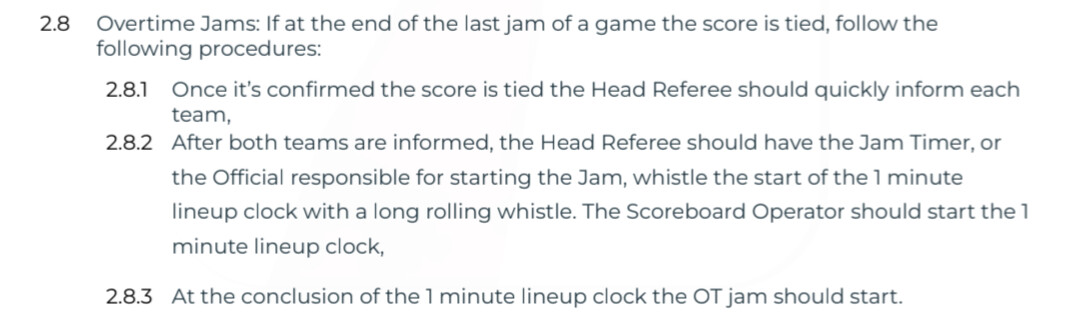
It also indicates the start of the lineup time before overtime, even when there is no timeout, per 2.8.2 of the officiating procedures. However I agree it isn’t ambiguous even in this case because the HR should also inform each team.
What is the problem that a new whistle type is designed to solve? Like Menace I cannot see a benefit, but I also don’t understand the concern as it seemed to me to be fully satisfied by updating the UI.
It just kind of bothers me, that the same whistle signal is used to indicate different things. In all other cases the rolling whistle indicates that skaters should start lining up or get ready for the start of the upcoming jam.
It is also kind of unclear what quickly informing the teams exactly implies. There is nothing in the officiating procedures that would mandate for there to be time for the team to coordinate between being informed and the rolling whistle being blown. Therefore we cannot assume that the HR having informed the teams implies that all the skaters have been informed. The fact, that the lineup period is increased to 60 seconds kind of indicates that this lineup should start as soon as possible without giving the teams any additional time to prepare (otherwise increasing the lineup time would not make much sense).
EDIT: Maybe 2.8.2 of the officiating procedures should be changed to: After ensuring that all participants have been informed, the Head Referee should have the Jam Timer, or
the Official responsible for starting the Jam, whistle the start of the 1 minute
lineup clock with a long rolling whistle. The Scoreboard Operator should start the 1
minute lineup clock,
As a jam timer I always think it is kind of awkward to stand there and wait after the clock has run down. Maybe it is just personal preference, but I would like there to be an additional signal. That is even more of a problem after the first period, since skaters will not be as aware of the period clock as at the end of the game. According to the rule the end of the first periods should however be handled the same as the end of the second period.
The confirmation of the teams is not enough, IMO. There would also need to be confirmation by the JRs, the SKs and the SBO that the points of the last jam are indeed recorded and displayed correctly. I am thus not sure, whether this practice is actually a good idea.